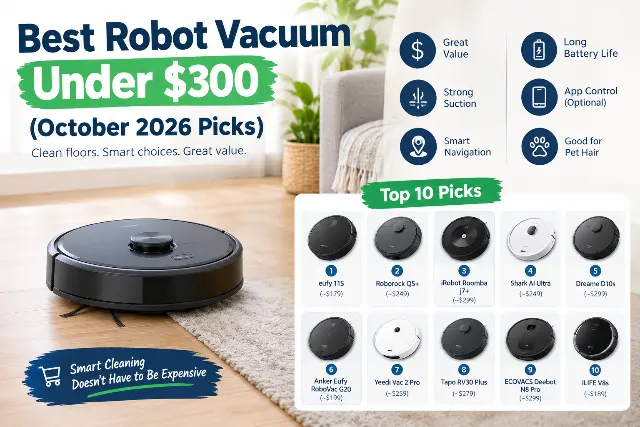
Best Robot Vacuum (October 2026 Picks)
The short answer
Is a robot vacuum worth it in 2026? Yes, absolutely. The features that just a few years ago—precise LiDAR mapping, 5,000+ Pa suction, and app-controlled no-go zones—are now standard in this price range. The real decision isn't if you should buy one, but which specific compromise you're willing to make: do you prioritize raw cleaning power, a self-emptying dock, or the lowest possible price?
Skip ahead to your pick
- Best Overall: Roborock Q5 Pro
- Best Self-Emptying Option: Shark IQ Robot
- Best for Less: Eufy 11S Max
How these made the cut
We don't lab-test vacuums. Instead, we synthesize hundreds of data points: owner reviews from retail sites, long-term reliability discussions on Reddit forums like r/robotvacuums, and recurring patterns in support complaints. We dismissed any model with widespread Wi-Fi connectivity issues, a pattern of getting stuck on simple thresholds, or an app that owners consistently describe as buggy or abandoned. For this guide, we focused on models frequently available for without relying on a one-off flash sale.
The single most important feature we looked for is navigation. A robot with mediocre suction that cleans systematically will always outperform a powerful one that bounces around randomly. That’s why our top picks use LiDAR or at least a smart gyroscope system. Random-path robots are cheap, but they miss huge areas and get trapped constantly. They aren't worth the frustration in 2026.
The standouts
Our overall pick: Roborock Q5 Pro (without dock)
The Roborock Q5 Pro, when sold without its auto-empty dock, is the smartest and most powerful robot vacuum you can consistently find. Its defining feature is its PreciSense LiDAR navigation. It maps your home with startling accuracy, cleans in efficient, predictable lines, and allows you to set precise no-go zones and invisible walls in the app. This is the same navigation tech found on Roborock models costing twice as much, and it's the reason the Q5 Pro rarely gets lost or stuck.
Its cleaning performance is just as impressive. With 5,500 Pa of suction and a dual rubber roller brush system, it pulls an incredible amount of dust and pet hair from both hard floors and low-to-medium pile carpets. That dual-roller design is a direct descendant of iRobot's premium models and is exceptionally resistant to hair tangles—a huge relief for pet owners. The app is polished, stable, and gives you granular control over your cleaning schedule, suction levels, and room-specific routines. It's a mature, reliable ecosystem.
The obvious trade-off is the lack of a self-empty dock at this price. You have to manually empty its 770ml dustbin after every one or two runs. This is a significant chore, but it's the compromise that gets you class-leading navigation and cleaning power. Some owners also report that its basic front-bumper obstacle avoidance can be clumsy with smaller items like charging cords or pet toys, so you'll need to do a quick tidy-up before it runs.
Buy this if: You want the best possible navigation and cleaning performance for your money and don't mind emptying the dustbin yourself. It's the best cheap robot vacuum for homes with a mix of carpets and hard floors, especially with pets.
Skip this if: The main reason you want a robot is to avoid daily chores. The manual emptying will become a hassle. You should get the Shark IQ Robot instead.
The value champion: Shark IQ Robot
The Shark IQ Robot with Self-Empty Base is often the cheapest self-emptying robot vacuum you can get from a major brand. Its appeal is simple and powerful: for you get a robot that cleans your floors and then empties itself into a bagless dock. You only have to think about it once every 30-45 days. For many, that convenience is the entire point.
Its cleaning is methodical, thanks to a VSLAM (camera-based) navigation system that builds a map of your home. While not as fast or precise as the Q5 Pro's LiDAR, it's a massive step up from random-bounce robots. It cleans in straight lines and eventually learns your layout. The real star is Shark's self-cleaning brushroll, which actively cuts hair off the roller as it cleans. Verified buyer feedback confirms this isn't a gimmick; it genuinely works and dramatically reduces the tedious maintenance of cutting away tangled hair.
However, the compromises are real. Shark doesn't publish official suction power (Pa) ratings, and owner reports suggest its performance on medium-pile carpet lags behind the Roborock Q5 Pro. The VSLAM navigation is also more sensitive to low-light conditions and can get confused if you move furniture around. The app is functional for scheduling and starting runs, but it lacks the advanced features like multi-floor mapping and intricate no-go zones found in the Roborock app. And while the bagless dock saves money on supplies, emptying it is a dusty, messy affair compared to a sealed bag system.
Buy this if: Your number one priority is a hands-off, self-emptying system on a tight budget, and you have mostly hard floors or low-pile carpets. The anti-hair-wrap feature is a lifesaver for pet owners.
Skip this if: You have a complex layout, lots of medium-pile carpet, or want precise control over where the robot cleans. The Roborock Q5 Pro is a much smarter navigator and deeper cleaner.
Best for less: Eufy 11S Max
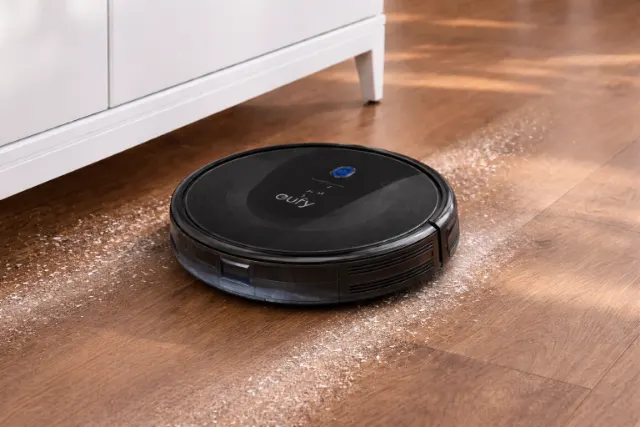
If your budget tops out at the eufy RoboVac 11S Max is the answer. Forget smart mapping, no-go zones, and self-empty docks. The 11S Max is a simple, reliable appliance that does one thing well: it sucks up daily dust and debris from hard floors and low-pile rugs. Its 2,000 Pa suction is surprisingly effective for its price, and its super-slim 2.85-inch profile lets it get under couches and dressers where taller, LiDAR-equipped robots can't fit.
This is a “dumb” robot. It uses a bounce-and-turn navigation logic, relying on infrared sensors to avoid walls and stairs. It doesn't know where it's been or where it's going, which means it will miss spots and can take an inefficient path. It's controlled by a simple infrared remote, not a smartphone app—there's no Wi-Fi. For some, this is a feature, not a bug. There are no connectivity issues, no firmware updates to brick the device, and no privacy concerns. You just press a button and it goes.
The main drawback is that random navigation. It's not suitable for large or complex floor plans, as it's likely to get trapped or fail to clean entire rooms. Its bristle brush also requires frequent cleaning to remove tangled hair, a stark contrast to the rubber rollers on the Roborock or the self-cleaning brush on the Shark. It’s a maintenance tool, not a deep cleaner. But for keeping the dust bunnies at bay in a small apartment or supplementing a full-size vacuum, its value is undeniable.
Buy this if: You have a simple, smaller layout with mostly hard floors and want a dead-simple, effective robot for. Its slim design is a major plus for getting under low furniture.
Skip this if: You have a home larger than 1000 sq ft, medium-pile carpets, or pets that shed heavily. You will be frustrated by its random cleaning pattern and constant brush maintenance.
Key Features to Look For
Smart Mapping: LiDAR vs. Gyroscope Navigation
This is the most important feature. LiDAR (Light Detection and Ranging) uses a spinning laser to create a highly accurate map of your home. It's fast, works in the dark, and enables precise room-by-room cleaning and no-go zones. It's the gold standard. VSLAM (Visual SLAM) uses a camera, which is cheaper but needs light to work and can be less accurate. Gyroscope-based navigation is a step down, using sensors to track turns and movement for a more methodical path than random bounce, but it's prone to drifting and getting lost. aim for LiDAR if you can get it (like the Roborock Q5 Pro).
Suction Power: What Do Pa Ratings Really Mean?
Pascal (Pa) ratings measure suction pressure. While higher is generally better, it's not the whole story. Brush design, filtration, and navigation efficiency are just as important. In 2026, a budget robot vacuum should offer at least 2,000 Pa for hard floors. For homes with carpets or pets, look for 4,000 Pa or more. Be wary of brands like Shark that don't publish Pa ratings; it usually means the numbers aren't competitive. The 5,500 Pa on the Q5 Pro is exceptional for this price point and makes a real difference on carpets.
Self-Empty Docks: Are They Worth It on a Budget?
A self-empty dock turns a robot vacuum from a daily-touch device into a weekly- or monthly-touch one. It's a huge quality-of-life upgrade. you'll likely find bagless docks, like the one on the Shark IQ. These save on the recurring cost of bags but are messy to empty. Bagged docks are more hygienic but add a long-term expense. If your budget forces a choice between a great robot (Q5 Pro) and a mediocre robot with a dock (many off-brand options), pick the great robot and empty it yourself.
The head-to-head, fast
| Product | Pet hair pickup | Carpet vs hard-floor suction | Navigation & mapping | Obstacle & cord avoidance | Edge & corner cleaning | Hair-tangle resistance | Verdict |
|---|---|---|---|---|---|---|---|
| Roborock Q5 Pro | Excellent | Excellent | Excellent | Fair | Good | Excellent | Best cleaner and navigator, if you empty it yourself. |
| Shark IQ Robot | Very good | Good | Good | Fair | Good | Excellent | The cheapest path to a hands-off, self-emptying system. |
| Eufy 11S Max | Good | Fair | Weak | Weak | Fair | Fair | A simple, reliable appliance for basic cleaning. |
Editorial assessments from aggregated owner feedback and manufacturer specifications — not independent lab tests.
Not worth your money
The budget market is flooded with models that look good on paper but fail in practice. Be wary of any robot that promises LiDAR and self-emptying—the corners cut on motor quality, battery life, and software support are severe. We also recommend skipping older premium models like the roborock Q7 M5+ Robot Vacuum and Mop or Roborock Q7 Max+. While they were great vacuums in their day, the Q5 Pro offers a stronger motor and better brush design for a similar or lower price in 2026. Likewise, the older roborock Q10 S5+ Robot Vacuum and Mop is completely superseded. Don't pay a premium for a name when a newer, better model from the same brand costs less.
The upkeep nobody mentions
Every robot vacuum, regardless of price, is a maintenance machine. The most overlooked task is cleaning the sensors. The cliff sensors on the bottom and the navigation sensors (whether LiDAR turret or camera) get dusty, which can lead to erratic behavior or error codes. Wipe them with a dry microfiber cloth every few weeks. Likewise, hair will eventually wrap around the ends of even the best brush rolls, and the side spinning brush will need to be replaced every 6-12 months. Filters need to be tapped out weekly and replaced every 2-3 months. A self-empty dock doesn't eliminate this; it just eliminates emptying the on-board dustbin. Expect to spend 5 minutes a month on basic upkeep to keep your robot running smoothly.
Should You Stretch Your Budget?
For most people, no. The sub- category is strong enough. But if you have a lot of medium-to-high pile carpet, the answer changes. Carpet is the ultimate test for a robot vacuum, requiring immense suction and an intelligent brush system. This is where models like the Eufy X10 Pro Omni justify their cost. It combines extremely high suction with a floating, tangle-free roller and, crucially, an auto-lifting mop. This means it can deep clean carpets and mop hard floors in a single run without dragging a wet pad across your rugs. Models like the Eureka E20 Evo Plus also enter the picture here, offering a complete package of LiDAR, strong suction, and a reliable self-empty dock without the compromises of the sub- Shark. If your home is primarily carpet, stretching your budget is a smart investment in a machine that will actually do the job well.
Frequently asked questions
Is a robot vacuum worth it in 2026?
Yes. In 2026, models offer features like LiDAR mapping and 5,000+ Pa suction, which were once premium. For daily cleaning in homes without heavy pet hair or complex layouts, they provide excellent value and save significant time, making them a worthwhile investment for most buyers.
What is the best robot vacuum?
Our pick is the Eufy 11S Max. It delivers strong 2,000Pa suction and has a very slim design that's ideal for getting under low furniture. While it lacks smart mapping and uses random navigation, it's a reliable and simple choice for scheduled cleaning on hard floors and low-pile carpets.
Do budget robot vacuums have smart mapping?
Many of the best ones now do. Models like the Roborock Q5 Pro feature advanced LiDAR navigation for efficient, systematic cleaning and app-based no-go zones. This is a significant upgrade from the random-bounce navigation found on older or sub- models and is worth prioritizing.
What's the best budget robot vacuum for pet hair?
For pet hair, you need high suction (over 5,000 Pa) and a tangle-resistant brush. The Roborock Q5 Pro with its dual rubber rollers is excellent. The Shark IQ Robot is also a strong contender, featuring a proven self-cleaning brushroll that actively cuts hair to prevent tangles.
Should I stretch my budget or stick to?
Sticking means accepting a compromise, like forgoing a self-empty dock with the Roborock Q5 Pro. If you have lots of medium-pile carpet, stretching your budget to the range for a model like the Eufy X10 Pro Omni gets you significantly better deep-cleaning performance.
Which is cheaper: a bagless or bagged self-empty dock?
A bagless self-empty dock has a lower long-term cost since you don't buy replacement bags. However, emptying the dock itself can be a messy, dusty chore. Bagged systems are far more hygienic but have a recurring cost per bag, which you'll replace every 1-2 months.
Products in this guide
eufy RoboVac 11S
★★★★★ ★★★★★ 3.8The eufy RoboVac 11S is a quiet, ultra-slim budget robot vacuum for hard floors, but its random navigation makes it a frustrating choice for most homes in 2026.
Roborock Q7 Max+
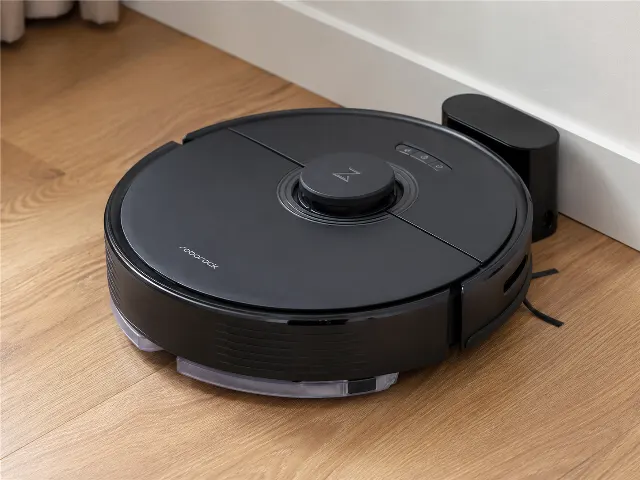
★★★★★ ★★★★★ 4.2The Roborock Q7 Max+ is a smart value in 2026 for its powerful suction and reliable auto-empty dock, but its basic obstacle avoidance is a liability in cluttered homes.

roborock Q7 M5+ Robot Vacuum and Mop
★★★★★ ★★★★★ 4.2The Roborock Q7 M5+ delivers exceptional vacuuming power for pet hair and carpets, but its mopping is strictly for light maintenance, not deep cleaning.

roborock Q10 S5+ Robot Vacuum and Mop
★★★★★ ★★★★★ 4.2The Roborock Q10 S5+ delivers immense suction and smart mopping, but its real value hinges on whether you can tolerate the dock's noise and ongoing upkeep.
More guides
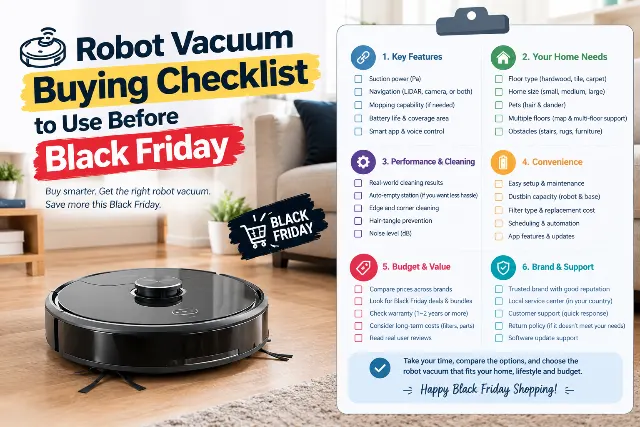
Robot Vacuum Buying Checklist to Use Before Black Friday
Don't buy a robot vacuum this Black Friday without our expert checklist. We cover the features that matter, the brands to watch, and what to skip in 2026.
Best Robot Vacuums of 2026: Picks for Every Home
Our 2026 robot vacuum review synthesizes owner feedback to name the best picks for pet hair, hardwood, and mopping, from budget to premium. We recommend the Dreame X60 Max Ultra Complete, Ecovacs Deebot T90 Pro Omni, and more.
Best Robot Vacuum With Self-Empty Base
Tired of emptying that tiny dustbin? We researched the best self-emptying robot vacuums for 2026. Our top picks for pet hair, budgets, and mopping.