LiDAR vs. Camera Navigation guide in Robot Vacuums: Which Is Better?
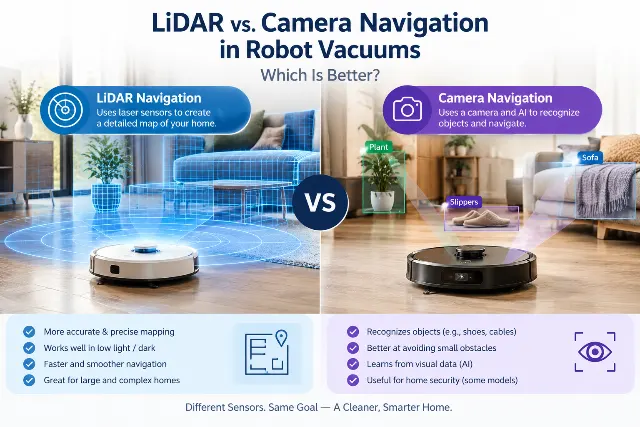
LiDAR vs. Camera Navigation in Robot Vacuums: Which Is Better in 2026?
Choosing between LiDAR and camera navigation can make a real difference in how reliably a robot vacuum cleans your home. LiDAR generally excels at mapping rooms and navigating in darkness, while camera-based systems can use visual information to understand their surroundings. Some of the most capable robot vacuums combine LiDAR with a front-facing camera or other sensors to improve obstacle avoidance.
The short answer: For most households, a LiDAR robot vacuum is an excellent choice if you want reliable mapping, systematic cleaning, and convenient room-by-room scheduling. If your home has pets, children, or frequently scattered cables and toys, consider a hybrid model with dedicated obstacle-recognition technology. Camera-based navigation may also be worth considering if a low-profile design is important, although actual furniture clearance depends on the entire robot's construction.
In this guide, we compare LiDAR vs. camera navigation across mapping accuracy, cleaning efficiency, low-light performance, obstacle avoidance, privacy, price, and furniture clearance. We also explain when each technology makes sense so you can choose a robot vacuum based on your home rather than marketing claims.
LiDAR vs. Camera Navigation: Quick Comparison
| Feature | LiDAR Navigation | Camera-Based Navigation | Hybrid Navigation |
|---|---|---|---|
| Mapping | Generally provides consistent distance-based mapping | Uses visual features to estimate position and build a map | Can combine laser mapping with visual information |
| Dark-room navigation | Usually performs well without visible light | Depends on camera type and available illumination | Usually performs well when LiDAR handles navigation |
| Small-object avoidance | Limited on its own | Can recognize objects when supported by suitable hardware and software | Can offer more capable object detection |
| Furniture clearance | A raised laser turret may increase robot height | Some designs have a lower profile | Depends on sensor placement and overall design |
| Room-specific cleaning | Common on mapping-enabled models | Available on supported mapping-enabled models | Available on supported models |
| Privacy considerations | Laser distance sensing does not inherently capture photographs | Camera use and image processing require consideration | Privacy depends on the cameras, software, and data handling |
| Best suited for | Reliable mapping and systematic navigation | Homes where visual navigation and a low-profile design are priorities | Homes needing mapping plus more advanced obstacle avoidance |
Important distinction: Navigation and obstacle avoidance are not the same thing. A robot can map an entire home accurately but still run into a charging cable. Always check the specific model's sensors and documented capabilities rather than assuming that every LiDAR or camera robot performs identically.
What Is LiDAR Navigation in a Robot Vacuum?
LiDAR stands for Light Detection and Ranging. A robot vacuum equipped with conventional rotating LiDAR typically has a raised circular turret containing a laser emitter and receiver. The system measures reflected laser light to estimate distances to surrounding surfaces, helping the robot determine its position and construct a map of the home.
Unlike a conventional camera, LiDAR does not need visible room lighting to measure distances. This makes it particularly useful when cleaning at night, underneath furniture, or in rooms where the lights are switched off.
How LiDAR Mapping Works
- Laser measurement: The sensor emits laser light and measures its reflections to estimate distances to nearby surfaces.
- Environmental mapping: The robot combines measurements with motion and localization data to build a representation of the surrounding space.
- Position estimation: The navigation system estimates the robot's location within the map.
- Route planning: The software uses the map to plan movements and organize cleaning coverage.
- Map updates: The robot can update its position and map as it encounters changes in the environment.
The result is often a systematic cleaning pattern rather than seemingly random movement. Depending on the model, the associated app may also support room selection, virtual boundaries, no-go zones, and multiple-floor maps.
Advantages of LiDAR Robot Vacuums
- Reliable mapping: Distance measurements help create consistent maps of walls, rooms, and other surfaces.
- Good low-light performance: Laser-based distance measurement does not depend on visible light.
- Organized cleaning: Mapping and localization can support efficient, planned cleaning routes.
- Room-level control: Many mapping-enabled models let users select particular rooms or define restricted areas.
- Convenient scheduling: Saved maps can help the robot follow repeatable cleaning routines.
Disadvantages of LiDAR Navigation
- Turret height: A raised sensor can prevent the robot from entering spaces beneath low furniture.
- Limited object recognition: Basic LiDAR mapping does not necessarily identify socks, cables, pet waste, or small toys.
- Environmental limitations: Reflective surfaces, glass, unusual layouts, and insufficient localization features can affect navigation.
- Model-dependent performance: A good sensor cannot compensate for poor navigation software, wheel traction, or mapping implementation.
Best for: Households that prioritize dependable mapping, systematic cleaning, scheduled operation, and navigation in darkness.
What Is Camera-Based Navigation (vSLAM)?
Camera-based navigation can use a technique called visual simultaneous localization and mapping, commonly known as vSLAM. A robot using this approach analyzes visual features in its surroundings to estimate where it is and how the environment is arranged.
Depending on the design, the camera may face upward to observe ceilings and other visual landmarks, or in another direction to capture environmental features. The software tracks those features as the robot moves and combines them with motion-sensor data to estimate its position.
Camera-based navigation should not be confused with camera-based obstacle avoidance. A camera used to estimate the robot's position does not automatically mean that the robot can recognize a power cord, identify pet waste, or distinguish a shoe from another object.
How Visual Navigation Works
- Image capture: The camera records visual information about the surrounding environment.
- Feature detection: Software identifies distinctive visual features that can help estimate position.
- Motion tracking: The system compares observations over time and combines them with movement data.
- Map construction: The robot builds or updates a representation of its environment.
- Navigation: The system uses its estimated position and available map to guide cleaning.
Advantages of Camera-Based Navigation
- Visual information: Cameras can capture environmental features that may be useful for localization.
- Potentially lower profile: Some camera-based designs avoid the raised LiDAR turret, although overall height varies by model.
- Flexible sensor integration: Cameras can be combined with other sensors and algorithms to support additional capabilities.
- Potential value: Some camera-based models offer useful navigation features at a lower price than comparable premium robots.
Disadvantages of Camera-Based Navigation
- Lighting sensitivity: Camera-based localization can become less reliable when visual information is insufficient, depending on the camera and illumination system.
- Environmental dependence: Plain or visually repetitive surroundings can make it harder to identify distinctive landmarks.
- Variable mapping performance: Accuracy depends on camera placement, processing capabilities, software, and sensor integration.
- Privacy considerations: A camera-equipped robot may capture images of rooms and household objects, so its data-handling practices deserve attention.
Best for: Buyers who find a particular camera-based model attractive because of its height, features, or price and whose home suits its navigation requirements.
LiDAR vs. Camera Navigation: Which Is More Accurate?
For many robot vacuums, LiDAR provides a strong foundation for accurate and repeatable room mapping because it measures distances directly. This can make it particularly useful for homes with several rooms, corridors, and complicated layouts.
Camera-based systems estimate position using visual features, so their performance depends partly on the availability and quality of those features. A well-designed visual navigation system can still perform effectively, and results vary substantially between models.
Neither technology guarantees perfect mapping. Glass walls, reflective surfaces, narrow spaces, moved furniture, wheel slippage, and other environmental factors can affect localization or coverage.
Which Is Better for Large Homes?
For a large home with multiple rooms, LiDAR is often a sensible starting point because consistent mapping can simplify room selection, scheduled cleaning, and route planning.
For a multi-floor home, check whether the robot supports multiple maps, can recognize the correct floor, and allows room-specific settings to be saved independently. These are software features, not automatic guarantees of LiDAR hardware.
A capable camera-based robot may also work well in a large home, but its actual mapping performance should be assessed at the model level rather than inferred from the presence of a camera alone.
Obstacle Avoidance: Why Hybrid Navigation Can Be Better
One of the most important distinctions in the LiDAR vs. camera debate is the difference between mapping a room and recognizing an object on the floor.
A conventional LiDAR sensor can help a robot measure nearby surfaces and determine its position, but it may not identify a small charging cable as a cable. Likewise, a basic navigation camera may be optimized for localization rather than object recognition.
More advanced robot vacuums combine mapping technology with front-facing cameras, structured-light sensors, infrared sensors, or other object-detection systems. Some use machine-learning models to classify obstacles and adjust their routes.
What Can a Hybrid Robot Vacuum Detect?
Depending on its hardware, software, and tested capabilities, an advanced obstacle-avoidance system may recognize or respond to:
- Charging cables and power cords.
- Shoes, slippers, and scattered toys.
- Some pet-related messes.
- Small household objects.
- Furniture legs and other obstacles in its path.
However, recognition performance varies. An object may be missed because of its size, shape, color, position, or lighting conditions. A robot advertised as having AI obstacle avoidance should not be assumed to detect every hazard.
Is Hybrid LiDAR Navigation Worth It?
Hybrid navigation can be worth the additional cost if your home regularly contains objects that a basic robot vacuum might encounter or become tangled in. It can also reduce the amount of preparation needed before a cleaning run.
However, advanced obstacle avoidance is not exclusive to LiDAR robots. Some camera-based robots also offer sophisticated object recognition. Compare the actual sensor configuration and independent test results instead of choosing a model solely because it uses a particular navigation label.
Buying tip: If your primary concern is avoiding pet waste, verify that the exact model has demonstrated performance against that specific hazard. No robot vacuum should be trusted to avoid every instance of pet waste automatically.
Performance in the Dark: Does LiDAR Have an Advantage?
LiDAR generally has a clear advantage when the robot must navigate without visible room lighting. Its distance measurements do not depend on a camera seeing visual details in the room.
Camera-based navigation is more variable. Some systems rely on visible light, while others incorporate infrared illumination or additional sensors that help them operate in low-light conditions.
For this reason, the presence of a camera does not automatically mean that a robot will fail in darkness. The relevant question is whether the specific navigation system has the hardware and software needed to operate reliably under your intended lighting conditions.
Which Navigation System Is Better for Night Cleaning?
If you regularly schedule cleaning after everyone has gone to bed, LiDAR is a practical choice because its distance-measurement method does not require visible light. A hybrid robot that uses LiDAR for localization and additional sensors for obstacle avoidance can offer further benefits.
Before buying a camera-based model for nighttime use, check the manufacturer's documentation for low-light operation and look for independent tests conducted in dark or dimly lit rooms.
Which Is Better for Pet Hair, Pets, and Children?
For households with pets or children, navigation and obstacle avoidance solve different problems.
LiDAR can help a robot follow systematic routes that cover the floor, making it useful for routine pet-hair cleaning. However, the amount of hair collected also depends on suction, brush design, anti-tangle performance, carpet type, and maintenance.
A robot with camera-based object recognition or another effective obstacle-detection system may be better equipped to respond to toys, cables, and other objects that could interrupt cleaning. The results depend on the exact model and the obstacles involved.
What Should Pet Owners Look For?
- Reliable mapping: Helps the robot cover the intended rooms systematically.
- Anti-tangle brush design: Helps manage hair wrapped around the main brush.
- Effective obstacle detection: May help the robot avoid toys, cables, and other recognized objects.
- Carpet performance: Matters if your pets shed heavily on rugs or carpets.
- Maintenance alerts: Can help you identify clogged filters, tangled brushes, and full dustbins.
- Pet-waste limitations: Check independent tests and never assume that AI recognition eliminates the risk of a collision.
For many pet owners, a hybrid robot with reliable mapping and well-tested obstacle avoidance is worth considering. However, a robot's ability to collect hair should be evaluated separately from its ability to identify objects.
Privacy: Is a Camera-Based Robot Vacuum Safe?
Privacy is another consideration when comparing LiDAR and camera navigation. Conventional LiDAR measures distances and does not inherently capture photographs of the room. A camera-equipped robot can collect visual information, depending on its design and operation.
That distinction does not mean every LiDAR-only robot is automatically secure or that every camera-equipped robot sends images to the cloud. Data collection and processing depend on the particular product, its software, and its settings.
How to Evaluate Robot Vacuum Privacy
- Read the manufacturer's privacy policy and documentation for the exact model.
- Check whether camera images are processed locally or uploaded to external servers.
- Determine whether cloud-connected features are optional or necessary for normal operation.
- Look for available camera controls, privacy settings, and account-security options.
- Review any independent security assessments and understand precisely what they cover.
- Check how long collected data is retained and whether deletion controls are available.
If you are uncomfortable with cameras operating inside your home, a model that does not use a camera may be preferable. You should still assess its connectivity, app permissions, account security, and other data-handling practices.
Can LiDAR Robot Vacuums Clean Under Low Furniture?
A raised LiDAR turret can make some robot vacuums too tall to fit beneath low sofas, beds, cabinets, and other furniture. In these situations, the robot's overall height may be more important than its mapping technology.
Camera-based designs can sometimes avoid a raised turret, but they are not automatically shorter. A robot may still be tall because of its body, bumpers, sensor placement, or other components. Some manufacturers also offer low-profile navigation systems designed to fit under furniture.
How to Check Furniture Clearance Before Buying
- Measure the vertical clearance beneath the furniture you want the robot to clean.
- Check the robot's official specifications for its total height, including any raised sensor assembly.
- Allow a practical margin instead of assuming that a robot will fit through an opening exactly equal to its listed height.
- Check whether the robot can enter and turn around in the available space.
- Consider whether its sensors can navigate effectively once it is underneath the furniture.
For example, if a sofa has approximately 9.7 cm of clearance, a robot taller than that opening will not fit underneath it. Even a robot that technically fits may struggle to turn or navigate effectively in a narrow space.
Buying tip: Measure your furniture before choosing between LiDAR and camera navigation. Do not assume that every LiDAR robot is too tall or that every camera-based robot will fit under low furniture.
LiDAR vs. Camera Navigation: Which Is More Affordable?
The price difference between LiDAR and camera-based robot vacuums depends on the market, manufacturer, product generation, and features included. Navigation technology alone does not determine the final price.
Some entry-level robots use basic navigation methods rather than either advanced LiDAR or visual SLAM. Meanwhile, premium camera-based and LiDAR-based robots may include sophisticated obstacle avoidance, automatic mop washing, self-emptying docks, or other expensive features.
What Affects the Price of a Robot Vacuum?
- Navigation hardware: LiDAR sensors, cameras, and additional sensing systems affect design and cost.
- Obstacle avoidance: More advanced detection systems may increase the price.
- Cleaning performance: Suction, brush design, and carpet-cleaning capabilities matter.
- Dock features: Automatic dust emptying, mop washing, and drying can add considerable cost.
- Software: Mapping, room controls, scheduling, and multi-floor support vary by model.
- Maintenance: Replacement filters, brushes, dust bags, and mop pads affect long-term ownership costs.
When comparing prices, evaluate robots with similar cleaning features and dock capabilities. A less expensive camera-based model may be a better purchase than a basic LiDAR robot if it meets your needs, while a well-equipped hybrid model may justify a higher price for a household that benefits from its additional capabilities.
Because prices and availability change, check current retailer listings and official manufacturer specifications before making a purchase.
What to Check Before Buying a LiDAR or Camera Robot Vacuum
Use this checklist to evaluate a specific model instead of relying on its navigation label alone.
- Mapping quality: Does it create reliable maps and support the rooms you want to clean?
- Dark-room performance: Can it navigate under your normal cleaning conditions?
- Obstacle avoidance: Which objects has the manufacturer documented or independent reviewers tested?
- Furniture clearance: Will the robot fit beneath your sofas, beds, and cabinets?
- Floor compatibility: Does it perform well on your carpets, rugs, and hard floors?
- Pet-hair management: Does the brush design suit the amount and type of hair in your home?
- App functionality: Does it support room selection, virtual boundaries, and the scheduling features you need?
- Privacy: Are the camera, cloud, and data-processing policies acceptable to you?
- Maintenance costs: What will replacement consumables cost over time?
- Independent reviews: Are there credible tests of navigation, obstacle avoidance, and cleaning performance?
The Verdict: Which Robot Vacuum Navigation Is Best in 2026?
For most buyers, LiDAR is an excellent choice for reliable mapping, systematic navigation, and cleaning in darkness. It provides a useful foundation for a robot vacuum that can follow repeatable routes and support convenient room-level controls.
However, LiDAR is not the only factor that determines how well a robot performs. A model with advanced object recognition may handle everyday clutter more effectively than one that relies on basic navigation alone. Camera-based navigation can also be a good choice when a particular robot offers the right combination of height, features, and price.
Choose a LiDAR robot vacuum if:
- You want consistent room mapping and organized cleaning routes.
- You plan to run the robot in darkness or at night.
- Your home has several rooms or a complicated layout.
- You want mapping-based features such as room selection and virtual boundaries.
Choose a camera-based robot vacuum if:
- A particular model offers the features and price you need.
- You prefer a lower-profile design and its measured height suits your furniture.
- The manufacturer's documented lighting requirements match your home.
- You have verified that its navigation system meets your expectations.
Choose a hybrid robot vacuum if:
- You want LiDAR-based mapping combined with additional obstacle detection.
- Your home regularly contains toys, cables, or other small objects.
- You have pets and want to reduce the risk of collisions with recognized hazards.
- You value convenience enough to justify the additional cost, if any.
Ultimately, the best robot vacuum is the one that maps your home reliably, cleans your floors effectively, fits beneath your furniture, and handles the obstacles it is likely to encounter. For many households, LiDAR provides a strong starting point. For cluttered homes, a well-implemented hybrid system may be the more practical choice.
Get More From Your Amazon Shopping With Prime
Amazon Prime combines eligible shopping, delivery, entertainment, and other membership benefits. Available features, prices, and eligibility depend on your location and membership plan.
Fast, Eligible Delivery
Get available delivery benefits on qualifying orders, subject to item and location eligibility.
Movies and TV Shows
Explore Prime Video titles and benefits available with your membership.
Exclusive Shopping Offers upto 50% off
Discover eligible member-only deals and shopping events.
Additional Benefits
Depending on your plan, other benefits may include selected music, reading, gaming, and more.
Is Prime worth it? Compare the membership price with the delivery, entertainment, and shopping benefits you expect to use before signing up.
Explore Amazon Prime Membership →
Affiliate disclosure: We may earn a commission if you sign up through this affiliate link and your referral qualifies, at no additional cost to you. Membership fees, free-trial eligibility, benefits, and offers may vary. Check Amazon's current terms before joining.
Frequently asked questions
Is LiDAR really worth the premium over camera navigation in robot vacuums?
Yes, for the vast majority of homes. LiDAR's superior mapping, reliability in all lighting conditions, and efficient cleaning paths prevent the constant getting-stuck issues that plague many camera-only bots. The small price difference in 2026 is easily justified by the lack of frustration.
Which navigation technology is better for homes with pets, LiDAR or vSLAM?
A hybrid LiDAR system with a front-facing camera is best. LiDAR ensures the entire floor gets covered for pet hair, while the camera's AI is crucial for identifying and avoiding pet toys, bowls, and especially pet waste—a catastrophic failure point for vacuums without this feature.
Are LiDAR-based robot vacuums more expensive than vSLAM ones?
Typically, yes, but the price gap has narrowed significantly. The laser turret and processing hardware add cost. However, the investment pays off with fewer manual rescues, more effective cleaning, and access to better software features like persistent no-go zones that actually work.
Can a robot vacuum have both LiDAR and vSLAM technology?
Yes, this is the new premium standard. These hybrid models use LiDAR for creating the main, highly accurate floor plan and a front-facing camera (using vSLAM principles) for spotting and identifying small, real-time obstacles like shoes or cables that the main laser can't see.
Why does low light matter so much for robot vacuum navigation?
Camera-only (vSLAM) vacuums are effectively blinded in low light because they navigate by seeing visual landmarks on your ceiling and walls. LiDAR uses its own laser light, so it maps and navigates with perfect accuracy in a bright room, under a dark bed, or at midnight.
Can LiDAR robot vacuums fit under low furniture?
Many cannot. The top-mounted LiDAR turret typically raises the unit's height to around 3.8-4 inches (9.5-10 cm). If you have couches or cabinets with less clearance, you'll need to seek out a camera-based model or a rare, specialized low-profile LiDAR unit.
More guides
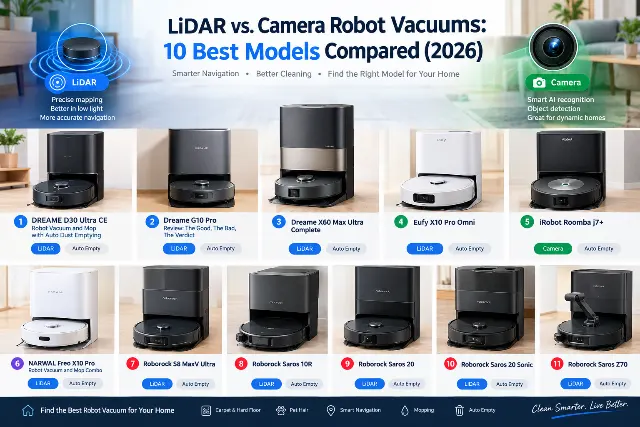
LiDAR vs. Camera Robot Vacuums: 10 Best Models Compared (2026)
Tired of your robot vacuum getting lost? We explain the real-world differences between LiDAR and camera (vSLAM) navigation, naming the best tech for your home, pets, and privacy.
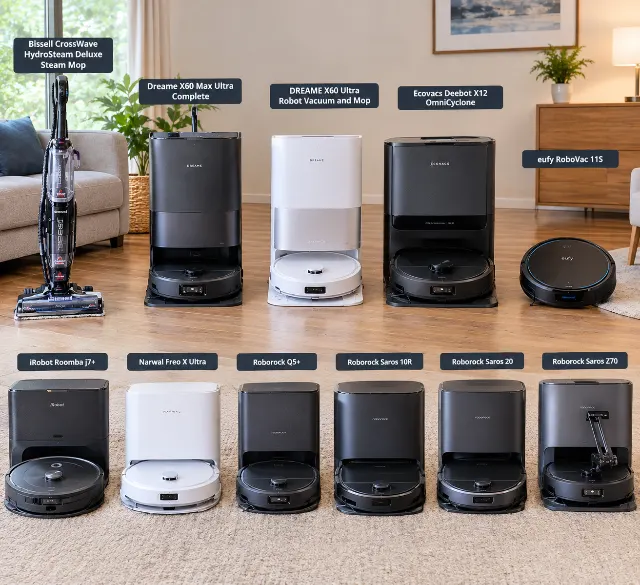
Robot Vacuum Trends 2026: What Changed This Year
Our expert 2026 guide to robot vacuum trends, technology, and top models. We name the best robot vacuums from Roborock, Dreame, and Narwal, and what to skip.
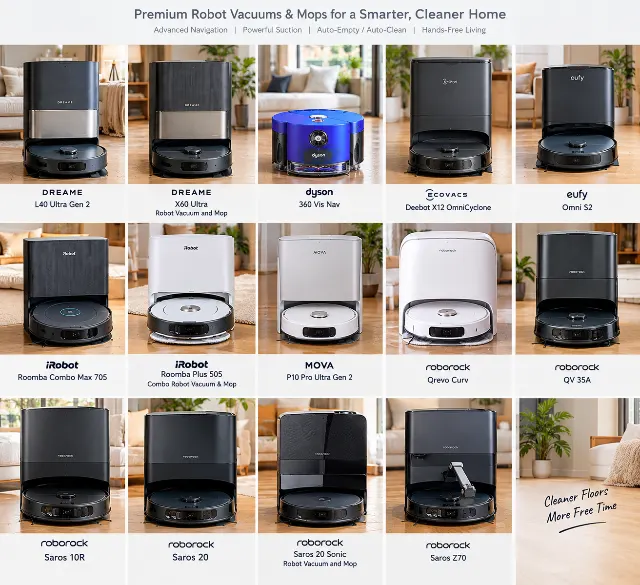
Best Robot Vacuum for Hardwood Floors
We researched the best robot vacuums for hardwood in 2026. Our top pick is the Roborock Saros 20 Sonic, but we also have picks for value, premium features, and beginners.