Robot Vacuum Pros and Cons: Are They Worth It in 2026?
Robot Vacuum Pros and Cons: Are They Worth It in 2026?
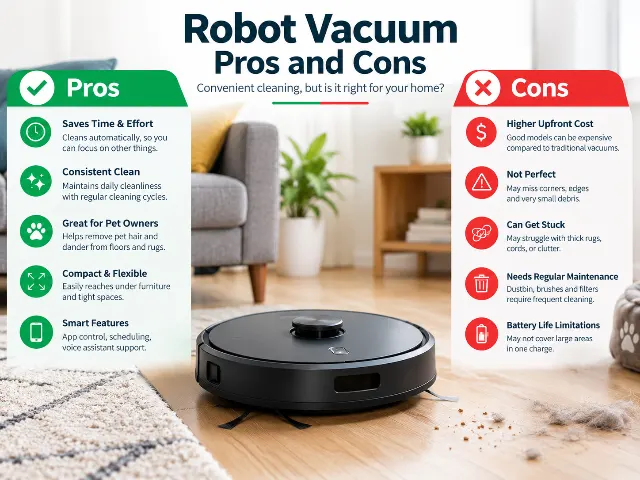
Robot vacuums can save time, control everyday dust and pet hair, and keep floors cleaner between deep cleans. However, they also have drawbacks, including upfront costs, maintenance requirements, navigation problems, and limitations on carpets and stubborn messes. This guide examines the real robot vacuum pros and cons, including vacuum-and-mop combinations, long-term ownership costs, and the features that matter most when choosing a model in 2026.
Quick verdict: A robot vacuum is worth considering if you want frequent, automated floor cleaning with less daily effort. It is less suitable for homes with persistent clutter, thick shag carpets, numerous stairs, or demanding deep-cleaning needs.

Robot Vacuums in 2026: Are They Finally Worth It?
Robot vacuums have evolved from basic automatic cleaners into connected appliances with room mapping, scheduled cleaning, obstacle detection, and increasingly sophisticated docking stations. Some premium models can automatically empty their dustbins, wash and dry mop pads, and refill water tanks.
These features make automated floor maintenance more convenient, but they do not make every robot vacuum equally effective. A model that performs well on hardwood floors may struggle with thick carpeting, while a robot with excellent suction may still get tangled in charging cables or miss dirt around furniture legs.
The most important distinction is between maintaining clean floors and replacing traditional vacuuming. Robot vacuums are generally better at collecting everyday dust, crumbs, and loose pet hair through frequent cleaning sessions than at handling neglected floors, deep-pile carpets, stairs, or upholstery.
Whether a robot vacuum is worth the money depends on four main factors:
- Your flooring: Hard floors and low-pile carpets are often easier to maintain than thick or high-pile rugs.
- Your household: Pets, children, and busy schedules can increase the value of automated cleaning.
- Your budget: The purchase price is only part of the cost; replacement parts and consumables matter too.
- Your expectations: A robot can reduce routine cleaning without eliminating every manual cleaning task.
Robot Vacuum Pros and Cons at a Glance
Before comparing features or models, consider the main advantages and disadvantages of owning a robot vacuum.
| Advantages | Disadvantages |
|---|---|
| Automates routine floor cleaning | Requires an upfront investment |
| Keeps dust and everyday debris under control | May miss corners and edges |
| Can reduce visible pet hair between deep cleans | Hair can still tangle around brushes |
| Offers scheduling and room-specific cleaning | Navigation can fail around clutter and cables |
| Can clean underneath suitable furniture | Low-clearance furniture may prevent access |
| Some models vacuum and mop automatically | Mopping and dock maintenance add work |
| Self-emptying docks reduce daily intervention | Dock bags, filters, and other consumables cost extra |
| Can clean while you work or are away | Cannot climb stairs or clean upholstery independently |
Bottom line: The main benefit is consistent cleaning with less effort. The main drawback is that convenience comes with financial costs, maintenance, and limitations that vary by model.
The Pros: Key Advantages of Owning a Robot Vacuum
1. Convenience: Automated, Hands-Free Cleaning
The biggest advantage of a robot vacuum is that it can clean on a schedule without requiring you to push it around the house. Once the robot is configured and the cleaning area is prepared, it can run while you work, cook, relax, or sleep.
Frequent cleaning also prevents small amounts of dirt from accumulating between manual vacuuming sessions. For busy households, this can mean less time spent removing crumbs, dust, and loose hair from frequently used rooms.
Self-emptying models reduce the need to empty the onboard dustbin after every run. More advanced docking stations automate additional tasks, although their water systems and cleaning components still require periodic attention.
Best for: Busy professionals, families with children, and people who want to reduce repetitive floor-cleaning tasks.
2. Effective Everyday Cleaning for Pet Hair and Dust
Robot vacuums can be particularly useful in homes with shedding cats or dogs. Running a suitable model regularly helps collect loose fur before it spreads across floors and accumulates along furniture edges.
Performance depends on the brush design, suction and airflow, floor type, hair length, and the robot's ability to cover the room. Rubber brushrolls can simplify hair removal on some models, while specialized anti-tangle designs may reduce maintenance. Neither feature guarantees that hair will never wrap around the brushes.
Filtration matters too. A well-sealed filtration system with an appropriate high-efficiency filter can capture fine particles collected by the vacuum. However, filtration specifications alone do not establish that a particular robot will meaningfully improve indoor air quality or relieve allergies.
For heavy shedders, look for a model that combines effective pet-hair pickup, accessible brushes, suitable filtration, and a dustbin or dock designed for frequent debris collection.
Best for: Pet owners who need regular maintenance cleaning between more thorough vacuuming sessions.
3. Smart Navigation and Room-Specific Cleaning
Many modern robot vacuums can map a home, divide it into rooms, and follow planned cleaning routes. Depending on the model, users can schedule specific rooms, adjust cleaning intensity, set no-go zones, and monitor progress through a mobile app.
LiDAR-based systems typically map rooms using laser measurements and can work effectively in low-light conditions. Camera-based navigation and other sensor combinations can also perform well, but results depend on the implementation and environment.
Advanced obstacle recognition may help a robot identify objects such as shoes, cables, or pet waste. However, detection is not foolproof. Small objects, unusual lighting, transparent items, and low-lying obstacles can still cause problems.
When evaluating navigation, prioritize reliable room mapping and obstacle handling over a feature list alone. Independent tests and owner reports can help reveal how a model performs in realistic homes.
Best for: Homes with multiple rooms where repeatable cleaning schedules and room-level controls are useful.
4. Reaches Under Furniture and Into Difficult Spaces
A robot vacuum's low profile can help it collect dust and debris under beds, sofas, and cabinets that are difficult to reach with a larger vacuum cleaner.
This advantage depends on the robot's actual height and the clearance beneath your furniture. Measure the lowest furniture opening before buying, and allow some extra clearance so the robot can pass without scraping or becoming trapped.
Round robot vacuums can still struggle with tight corners and some edges. Side brushes help sweep debris toward the intake, but they cannot guarantee complete cleaning along every wall or furniture boundary.
Best for: Homes with accessible under-furniture spaces and relatively uncluttered floors.
5. Flexible Scheduling and Smart Home Controls
App-based scheduling allows a robot vacuum to clean when it is least disruptive. You may be able to set different schedules for the kitchen, living room, and bedrooms, or increase cleaning frequency in areas that collect more dirt.
Some models support voice assistants and selected smart home platforms. Compatibility varies by brand, model, region, and software version, so check the manufacturer's current specifications rather than assuming every robot supports every ecosystem or the Matter standard.
Useful controls can include:
- Room-by-room and zone cleaning.
- Scheduled cleaning and temporary pauses.
- Adjustable suction and, on applicable models, water flow.
- Virtual boundaries and restricted areas.
- Cleaning history, maintenance reminders, and consumable status.
Best for: People who want predictable cleaning routines and remote control without operating the vacuum manually.
6. Reduced Daily Effort With Self-Emptying Docks
A self-emptying dock transfers collected debris from the robot's onboard bin into a larger bag or container. This reduces how often you need to empty the robot yourself and is particularly useful when cleaning frequently or managing substantial amounts of pet hair.
Some premium all-in-one docks also wash and dry mop pads and replenish water. These features can make combined vacuuming and mopping more practical, but they introduce additional parts and cleaning tasks.
Check dock dimensions, noise, bag availability, replacement costs, and maintenance requirements before paying extra. A simpler dock may offer better value if you have a small home or do not mind emptying the bin regularly.
The Cons: Common Robot Vacuum Disadvantages
1. High Initial Cost and Ongoing Ownership Expenses
A robot vacuum may cost substantially more than a basic traditional vacuum, particularly when it includes advanced navigation, obstacle avoidance, a self-emptying dock, or automated mop washing.
Prices vary by brand, model, region, promotions, and included accessories. Rather than assuming one price range applies to every market, compare current prices for the exact models you are considering.
The full ownership cost may include:
- The robot and its docking station.
- Replacement filters, side brushes, and main brushes.
- Dust bags for compatible self-emptying docks.
- Mop pads, cleaning solution, and other model-specific consumables.
- Battery replacement or repairs when needed.
Replacement intervals depend on usage, manufacturer guidance, environmental conditions, and the condition of each component. A heavily used robot in a home with multiple shedding pets may need more frequent maintenance than one used occasionally in a small apartment.
Buying tip: Compare the purchase price with the estimated cost of consumables over two or three years. Confirm that replacement parts are readily available in your market.
2. Limited Deep Cleaning on Certain Carpets
Robot vacuums are designed primarily for floor-level cleaning, and their performance varies considerably across flooring types. Many handle hard floors and low-pile carpets well, but thick rugs and high-pile or shag carpets can create challenges.
Depending on the design, a robot may struggle to climb onto a rug, move across dense fibers, extract embedded dirt, or avoid getting its brushes caught. Some models automatically increase suction on carpets, but this feature does not guarantee deep-cleaning performance.
Advertised suction pressure, measured in pascals (Pa), is useful as one specification but should not be treated as a universal ranking of cleaning ability. Brush design, airflow, intake geometry, carpet construction, and independent pickup tests also matter.
Best alternative: If your home has thick carpeting or requires frequent deep cleaning, retain a suitable upright or cordless vacuum even if you purchase a robot.
3. Corners, Edges, and Missed Debris
The circular shape of many robot vacuums makes tight corners difficult to clean thoroughly. Side brushes can sweep some debris toward the intake, but particles may remain along baseboards, behind furniture, or in narrow spaces.
Navigation algorithms also need to balance coverage, battery life, and obstacle avoidance. A robot can miss small patches, avoid an inaccessible area, or require another pass to collect stubborn debris.
Models with edge-cleaning features may improve coverage, but results should be verified through independent testing rather than inferred from marketing claims.
4. Getting Stuck on Cables, Rugs, and Clutter
Robot vacuums work best when floors are reasonably clear. Charging cables, socks, small toys, rug tassels, and lightweight objects can interfere with navigation or become trapped in the brushes.
Obstacle avoidance reduces some of these problems, but no sensor system identifies every object in every environment. Even a premium model can struggle with unusual layouts, dark surfaces, low-clearance furniture, or objects that are difficult for its sensors to detect.
Before a cleaning run, move loose cables and small objects, secure rug fringes where possible, and establish no-go zones around areas that repeatedly cause trouble.
Important for pet owners: Never assume that obstacle recognition will always detect pet waste. A robot can spread a mess if it fails to recognize and avoid it.
5. Regular Maintenance Is Still Necessary
Although robot vacuums reduce manual floor cleaning, they are not maintenance-free. Hair and fibers can collect around brushes and wheels, while dust can obstruct filters and sensors.
Depending on the model, routine care may include:
- Removing hair and debris from the main and side brushes.
- Emptying the dustbin or replacing the dock bag when necessary.
- Cleaning sensors and charging contacts according to the manual.
- Inspecting wheels and clearing trapped debris.
- Replacing worn filters, brushes, and batteries as required.
- Cleaning mop pads and washing or emptying dock components on combo models.
Ignoring maintenance can reduce pickup performance, interfere with navigation, and create avoidable odors. Consider how much routine care you are willing to perform before choosing a more complex model.
6. Battery and Coverage Limitations
A robot vacuum must balance cleaning coverage with its available battery capacity. Larger homes, higher suction settings, thick carpets, and complicated routes can increase energy use and extend cleaning time.
Some robots return to their dock to recharge and resume cleaning automatically. Others may require more intervention, depending on their capabilities and configuration.
Compare manufacturer-rated runtime with independent tests and consider the size of your cleanable floor area, not simply the advertised battery life. For larger homes, reliable recharge-and-resume functionality may be more valuable than a single impressive runtime figure.
7. Noise, Privacy, and Connectivity Concerns
Robot vacuums are not silent. Noise can come from the onboard motor, brushes, wheels, and especially the automatic-emptying cycle. If you plan to run a robot while sleeping or working, review noise measurements and scheduling options where available.
Connected models may collect maps, device information, usage records, or camera-related data, depending on their hardware and software. Privacy practices differ between manufacturers.
Review the manufacturer's privacy policy, app permissions, account security options, camera controls, and cloud-data settings. If you prefer fewer connected features, consider whether a simpler model meets your cleaning needs.
Robot Vacuum and Mop Combo: Pros and Cons
A robot vacuum and mop combines dry debris collection with light wet cleaning. For homes with mostly hard flooring, this can reduce the number of separate cleaning tasks. However, a combo unit is not automatically better than a vacuum-only model.
Advantages of Robot Vacuum-Mop Combos
- Two cleaning functions: Suitable models can vacuum debris and mop compatible hard floors in one cleaning routine.
- Less manual work: Scheduled mopping can help control everyday fine dust and light surface marks.
- Automated dock options: Selected systems wash and dry mop pads and manage clean and dirty water.
- Flexible cleaning: Some models can lift or remove their mop attachments when cleaning carpets.
Disadvantages of Robot Vacuum-Mop Combos
- Higher cost: Advanced mop systems and multifunction docks can increase the purchase price.
- More maintenance: Water tanks, mop pads, trays, and internal dock components require cleaning.
- Limited stain removal: Routine mopping may not remove dried food, sticky spills, or stubborn stains.
- Carpet restrictions: Mop lifting and carpet-avoidance performance vary by model and settings.
- Flooring compatibility: Some surfaces should not be wet-cleaned, so follow the flooring manufacturer's care instructions.
Which should you choose? Choose a vacuum-mop combo if your home has mostly compatible hard floors and you value automated maintenance mopping. Choose a vacuum-only model if your home is mainly carpeted or you rarely need automated wet cleaning.
Neither option eliminates the need for occasional manual cleaning. The best choice depends on which cleaning tasks you want to automate.
Are Robot Vacuums Good for Pet Hair?
Yes, a suitable robot vacuum can be effective for routine pet-hair removal, especially on hard floors and low-pile carpets. However, performance varies by model, pet breed, hair length, floor covering, and the amount of shedding.
When shopping for a robot vacuum for pet hair, prioritize:
- Effective hair pickup: Look for independent tests involving pet hair on flooring similar to yours.
- Manageable brush maintenance: Anti-tangle designs can help, but inspect how easily hair can be removed.
- A suitable filtration system: Check the filter specifications and overall system design if fine-particle containment is important.
- Adequate dust capacity: A self-emptying dock can reduce how often you handle collected fur.
- Reliable obstacle avoidance: Useful in pet households, but not a guarantee against pet-waste accidents.
Daily or frequent scheduled cleaning may help prevent loose fur from accumulating. Nevertheless, a traditional vacuum may still be necessary for deeply embedded hair, upholstery, stairs, and areas the robot cannot reach.
How Much Does a Robot Vacuum Really Cost?
The total cost depends on the robot's features, local pricing, consumables, and how long you keep it. A lower purchase price is not always the cheapest option over several years, particularly if replacement parts are expensive or difficult to find.
| Type | Typical capabilities | Main trade-off |
|---|---|---|
| Entry-level robot | Basic scheduled cleaning and simpler navigation | More manual intervention and potentially less precise coverage |
| Midrange robot | More capable mapping, room controls, and optional self-emptying | Higher price for convenience and navigation improvements |
| Premium robot | Advanced obstacle avoidance and potentially automated mop care | Higher purchase and potential repair or consumable costs |
These categories describe common feature patterns, not fixed specifications. Features and pricing vary considerably, and a premium model does not necessarily outperform a less expensive competitor in every cleaning test.
How to Calculate Your Total Cost of Ownership
Use this simple calculation before purchasing:
Total ownership cost = purchase price + replacement parts + consumables + expected repairs − resale value.
For a fair comparison, estimate costs over the same period for each model. Include dust bags, filters, brushes, mop pads, cleaning solution, and battery replacement if applicable. Also consider whether the time saved is valuable enough to justify the additional expense.
For current prices, verify the exact model and its included dock, accessories, warranty, and regional availability before comparing offers.
How to Choose the Right Robot Vacuum for Your Home
The best robot vacuum is not necessarily the one with the highest advertised suction or the longest feature list. Start with your home's biggest cleaning challenge, then compare models that address it effectively.
Best Robot Vacuum Features for Pet Owners
Prioritize tested pet-hair pickup, brush designs that are easy to maintain, a suitable filtration system, and sufficient dust capacity. A self-emptying dock is particularly useful for homes with heavy shedding. Do not rely on suction ratings alone to predict hair removal.
Best Robot Vacuum for Carpeted Homes
Look for independent carpet-pickup results, reliable movement over your carpet's pile, and a design that can handle the thickness of your rugs. Automatic carpet-boost settings can help, but verify that the robot can physically navigate your flooring. Keep a traditional vacuum for deep cleaning where necessary.
Best Robot Vacuum for Hardwood and Tile Floors
For hard floors, prioritize reliable fine-dust and debris pickup, edge coverage, and navigation around furniture. A mop combo may be worthwhile if the flooring is compatible with wet cleaning and you want help managing light surface dirt.
Best Robot Vacuum for Small Apartments
A compact robot with reliable mapping, manageable maintenance, and a suitably sized dock may offer better value than an expensive all-in-one system. Measure the available dock space and check whether the robot can pass under your furniture. In a very small or heavily cluttered apartment, a cordless stick vacuum may be more practical.
Best Robot Vacuum for Large Homes
Consider battery endurance, recharge-and-resume functionality, room mapping, dust capacity, and the dock's ability to manage frequent cleaning. Check whether the model supports the required floor area and whether its app can schedule individual rooms effectively.
Which Navigation System Is Better?
LiDAR navigation is often effective for systematic mapping and can operate without relying on visible light. Camera-based systems can provide useful visual recognition, while other sensors help detect walls, drops, and obstacles. The overall implementation matters more than the sensor label alone.
For cluttered homes, prioritize independently demonstrated obstacle avoidance. For straightforward layouts, a reliable mapping system may be more important than advanced object recognition.
Which Features Are Worth Paying Extra For?
- Reliable mapping: Valuable for repeatable room-by-room cleaning.
- Self-emptying: Worth considering if frequent dustbin emptying is inconvenient.
- Anti-tangle brushes: Helpful in homes with long hair or shedding pets, although no design is completely maintenance-free.
- Obstacle avoidance: Useful when small objects are difficult to remove before each cleaning run.
- Automated mop washing: Most valuable if you regularly use the mopping function.
- Recharge and resume: Helpful for larger homes and extended cleaning sessions.
Robot Vacuum vs. Traditional Vacuum: Which Is Better?
Robot vacuums and traditional vacuums serve different purposes. A robot emphasizes regular automated floor maintenance, while a traditional vacuum usually provides greater flexibility for targeted cleaning and areas above floor level.
| Cleaning task | Robot vacuum | Traditional vacuum |
|---|---|---|
| Scheduled daily floor cleaning | Usually more convenient | Requires manual operation |
| Cleaning under suitable furniture | Often convenient | Depends on the attachment and clearance |
| Stairs and upholstery | Not suitable for independent cleaning | Suitable with the appropriate design or attachment |
| Deep cleaning thick carpets | Model-dependent and often limited | Often preferable with a suitable vacuum |
| Cleaning around clutter | May require preparation and supervision | Offers more direct control |
| Hands-free routine cleaning | Main advantage | Generally requires more effort |
For many households, the best arrangement is to use a robot for routine cleaning and retain a traditional vacuum for deep cleaning, stairs, upholstery, and difficult areas. If you must choose only one appliance, consider which tasks you perform most frequently rather than assuming automation is always the better investment.
Who Should and Shouldn't Buy a Robot Vacuum in 2026?
You Should Consider Buying One If:
- You want to reduce the time spent on routine floor cleaning.
- Your household produces regular dust, crumbs, or loose pet hair.
- Your floors are mostly hard surfaces or compatible low-pile carpets.
- You can keep cables and small objects out of the robot's path.
- You value scheduled cleaning and are comfortable maintaining the appliance.
- You can afford the purchase price and ongoing consumables.
You May Be Better Off Without One If:
- Your home has extensive thick or shag carpeting that the robot cannot clean effectively.
- Your floors are frequently covered with toys, cables, clothing, or other obstacles.
- You need one appliance to clean stairs, furniture, upholstery, and cars.
- You have limited space for the robot and its docking station.
- You do not want to clean brushes, sensors, filters, or mop components.
- A traditional vacuum offers better value for your particular cleaning needs.
Final recommendation: Buy a robot vacuum for the convenience of frequent, automated maintenance rather than expecting it to replace every cleaning tool in your home. Match the model to your flooring, layout, and maintenance preferences, and verify its real-world performance before spending more for premium features.
How to Evaluate Robot Vacuum Claims
Robot vacuum specifications and advertised features do not always translate into equivalent real-world performance. Before buying, compare the exact model using independent cleaning tests, manufacturer documentation, warranty terms, and current regional pricing.
This guide provides general buying advice and does not claim that every listed feature is present in every 2026 model. Product performance, prices, compatibility, and software capabilities can change over time. Readers should verify current specifications before purchasing.
Frequently asked questions
What are the pros and cons of a robot vacuum with a mop?
Combo units are convenient, saving time by cleaning and mopping simultaneously. However, they cost more, require extra maintenance for tanks and pads, and their mopping pressure can't match manual scrubbing for tough, dried-on stains. They are best for maintaining already clean hard floors.
How efficient is a robot vacuum for pet hair?
Modern robots are extremely efficient for pet hair. Models with high suction (over 7,000Pa), anti-tangle rubber brushes, and HEPA filters excel at lifting fur from all floor types without clogging. For pet owners dealing with daily shedding, they are a genuinely effective solution.
What are the most common complaints about robot vacuums?
The most frequent complaints are the high initial price, the constant need for maintenance like cleaning brushes and sensors, and weaker suction than traditional vacuums. Owners also report navigation issues, with robots getting stuck on rug tassels, electrical cords, and under low furniture.
Should I get a robot vacuum with or without a mop?
Get a model with a mop if you have mostly hard floors and want to manage fine dust and light spills automatically. A vacuum-only robot is a more cost-effective choice if your home is primarily carpeted or if you only need to control dry debris like crumbs and pet fur.
Can you integrate a robot vacuum into a smart home system?
Yes, almost all current robot vacuums connect to Wi-Fi and integrate with Amazon Alexa and Google Assistant for voice control. Many now also support the Matter protocol, allowing you to start, stop, and schedule cleanings within your primary smart home app for unified control.
How do you choose a good robot vacuum?
Focus on features that match your home. Prioritize LiDAR navigation for accuracy, high suction power (7,000Pa+) for carpets and pets, and rubber brushes to resist hair tangles. A self-emptying dock is the single most important feature for reducing your own manual effort and is worth the extra cost.
More guides
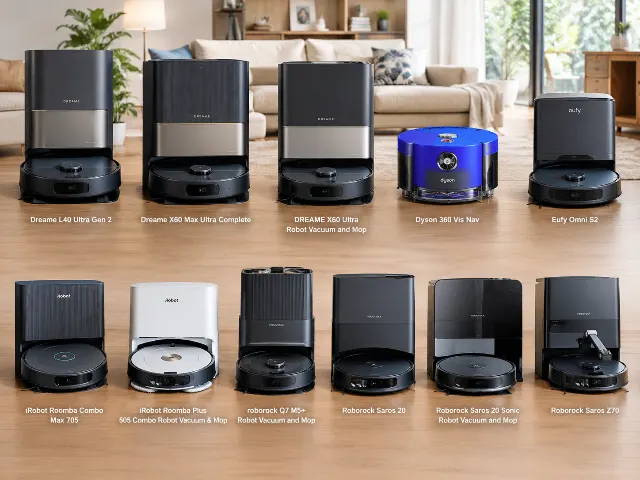
Best Robot Vacuum for Pet Hair
Tired of pet hair tumbleweeds? We researched dozens of models to find the best robot vacuums that actually handle fur, avoid pet waste, and don't get stuck.
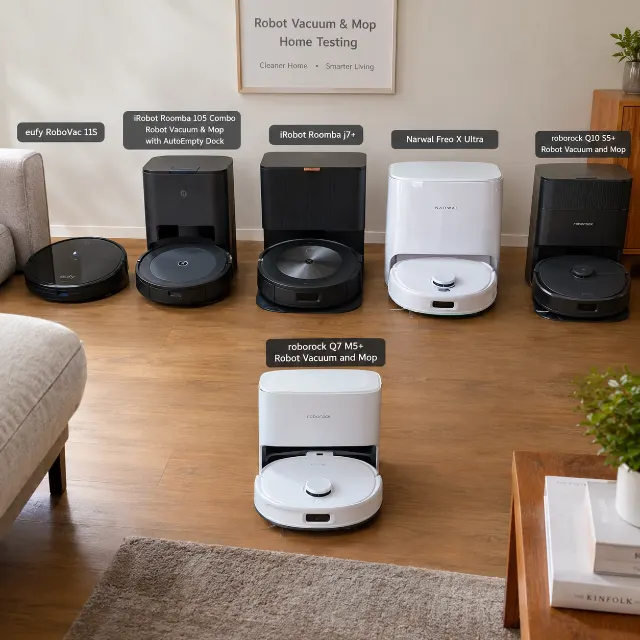
The Best Budget Robot Vacuum: Picks
Tired of junk robot vacuums? We researched the best budget models that actually clean. Find our top picks for pet hair, carpets, and more.
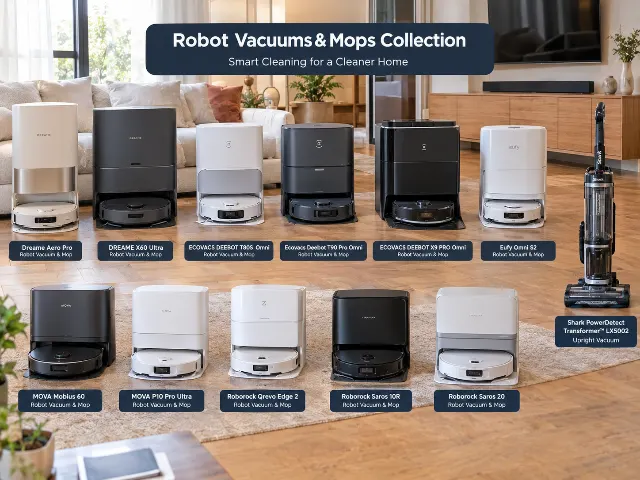
Best Robot Vacuums (2026): Top Picks & Reviews
We researched the best robot vacuums of 2026. After analyzing owner reviews and specs, we recommend the Roborock Qrevo CurvX, Mova V50, and more.